
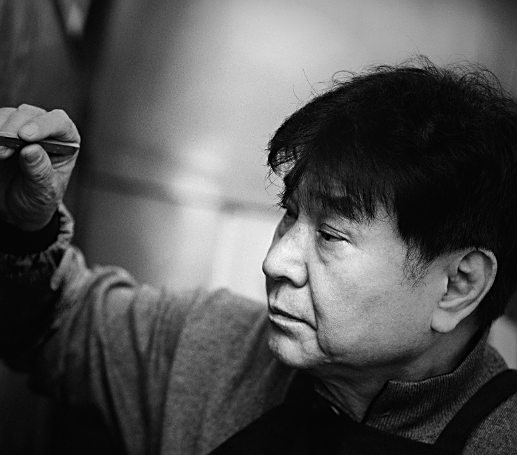
Portrait courtesy of the artist
Lacquer
Hwankyeong Kim
Chaehwa Chiljang, Seoul Intangible Cultural Heritage No. 1
Practice
Kim Hwan-gyeong works in chaehwa, painted lacquer, a technique historically distinct from the inlay tradition more commonly associated with Korean lacquerware. Trained in joinery workshops in the 1960s where lacquer application was inseparable from woodwork, he turned to painting in the early 1970s and developed his chaehwa practice through the 1980s.
In 2004, the City of Seoul designated him Chaehwa Chiljang, holder of Intangible Cultural Heritage No. 1 in this discipline. His standing is a matter of institutional record, not self-designation. He continues to work through the Cheongmok Lacquer Research Institute.
Lineage
1999 | presented a chrysanthemum-motif lacquer mirror to Queen Elizabeth II during her state visit to Korea 2004 | designated Seoul Intangible Cultural Heritage No. 1, Chaehwa Chiljang 2006 | Grand Prize, Korea Culture and Arts Awards, craft division 2010 | commissioned to produce official gifts for the spouses of G20 heads of state 2012 | cross-cultural exhibition, Shanghai Museum of Arts and Crafts 2013 | exhibition, Seoul–Rome Intangible Cultural Heritage Preservation Society, Italy
Atelier
Workshop
Photography by casa serico
Collection
Related works

Lacquer
No. 1
A black lacquer box worked in dense repeat: chrysanthemum heads in red, violet, and pewter cover the case in a continuous field, broken only by an inlaid octagonal clasp. The pattern reads as field rather than illustration, no single motif is asked to carry the surface alone.
View work
Lacquer
No. 2
An archaic script, closer to seal-form characters than to decorative pattern, repeats across a green ground in gold and vermilion, arranged as a field rather than a text meant to be read in sequence. A study in pattern-as-structure: the characters carry weight through repetition, not meaning through translation.
View work
Lacquer
No. 3
The same archaic-script field as No. 2, restated on a vermilion-orange ground with the character strokes shifted to blue and olive. Read alongside No. 2, the pair functions as a controlled study in how ground color alone changes the temperature of an identical pattern.
View work
Lacquer
No. 4
Kim's one unornamented piece in this group: a low lacquer table built on joinery alone, the black surface left to carry the work rather than any applied pattern. Set beside the boxes, it argues that restraint and density are two settings of the same practice, not opposing ones.
View work
Lacquer
No. 5
A quieter register than No. 1: a floral vine pattern rendered in soft, desaturated color against a near-black ground, the individual blossoms smaller and more widely spaced. Closes this sequence on its most legible, least dense composition.
View work