
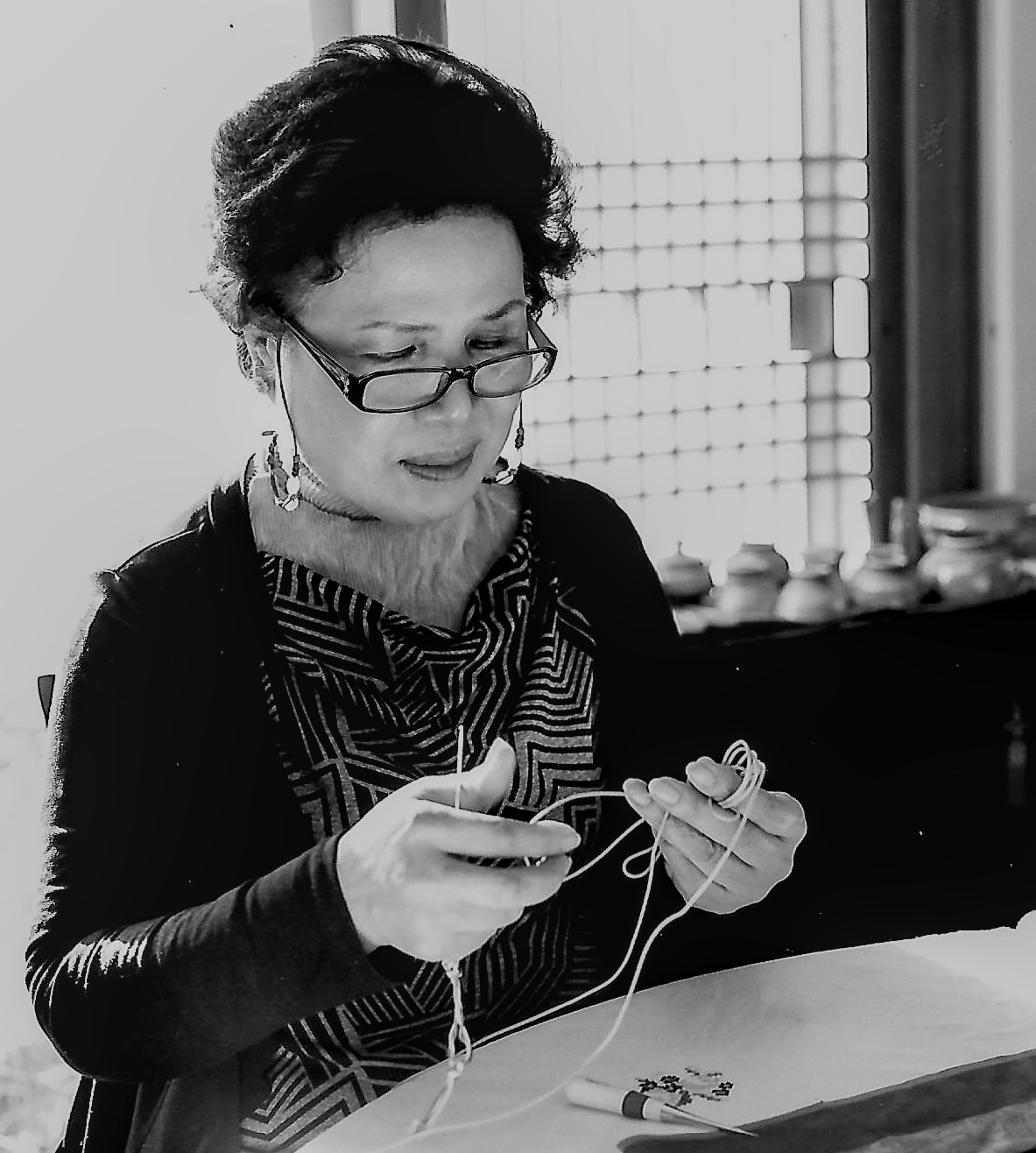
Portrait courtesy of the artist
Textile
Soonja Hwang
Knot Master, Hwangsil Cultural Foundation
Practice
Hwang Sun-ja works in maedeup, traditional Korean knotting, a discipline historically distinct from surface ornamentation techniques such as inlay or lacquer, operating instead through cord, tension, and structural knotting alone. She trained from 1982 under the late Kim Ju-hyeon, with further formation in traditional sewing and netting techniques under separate masters, before founding the Korea Knot Craft Association in 1984, which she subsequently chaired.
In 2008, she was recognized as a research fellow in modern cultural heritage craft by the Cultural Heritage Administration and designated a Master (Myeongin) by the Hwangsil Cultural Foundation, a private institution distinct from Korea's state intangible heritage system. Her exhibition record includes presentations at the 104th Paris International Fair (2008) and the Korean Cultural Centre, London (2009), placing her practice within direct contact with European exhibition contexts rather than domestic circulation alone.
Lineage
1982 | began training under Kim Ju-hyeon. 1984 | founded, and later chaired, the Korea Knot Craft Association. 1988 | organized the 4th International Knot Exhibition, Seoul, establishing the exhibition line that extended to the 11th International Knot Exhibition, Kyoto Cultural Museum, Japan. 2008 | research fellow designation, Cultural Heritage Administration, modern cultural heritage craft field; presentation, 104th Paris International Fair, France. 2009 | exhibition, Korean Cultural Centre, London, United Kingdom. 2010 | Craft Transmission Award, Cultural Heritage Administration, for a reinterpretation of the 108-bead Buddhist rosary in traditional knotting technique.
Atelier
Workshop
Photography by casa serico
Collection
Related works

Textile
No. 1
A lattice-backed chair built as ground for textile rather than the reverse: a silk brocade seat and back cushion in violet, with tasseled cord work draped over both arms in the manner of norigae ornament. Furniture and textile are not separated here, the wood exists to hold the silk.
View work
Textile
No. 2
A norigae, cord, tassel, and coin ornament traditionally worn rather than displayed, mounted and framed as a standing textile work. Removing it from the body changes its register entirely: what was ornament becomes composition.
View work
Textile
No. 3
An embroidered panel worked in silk thread, showing a confronted pair of spotted cats against cloud and wave motifs, mounted with cord and tassel and framed for wall display. Draws on the same guardian-animal imagery found in Jeong's paintings, worked here in thread rather than pigment.
View work