
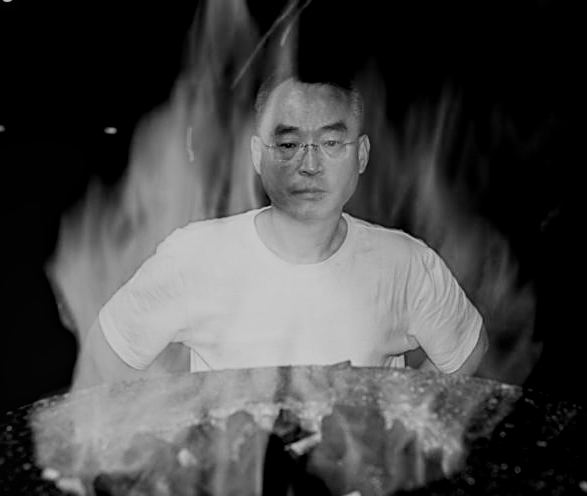
Portrait courtesy of the artist
Blade
Jeongwuk Han
Practice
Han Jeong-uk works in sacheol smelting, a pre-industrial method of forging steel directly from iron-bearing sand rather than refined ore, producing a folded, layered blade structure historically associated with pre-Joseon and early Joseon metalwork. The technique had no continuous practitioner in Korea when he began; there was no workshop to join, no master to train under. Working from historical gazetteers, including the Sejong Sillok Jiriji and the Sinjeung Dongguk Yeoji Seungnam, he located historical sand-iron production sites and reconstructed the smelting process independently, beginning in 1981.
This is not a lineage practice. Its authority rests on a different basis: a documented, sourced reconstruction of a technique with no other current practitioner in Korea, verifiable against the historical record rather than against a chain of transmission.
Lineage
1954 | born, Seoul 1981 | began independent research and reconstruction of sacheol smelting, based on historical gazetteer records 2001 | opened Korea's first dedicated knife exhibition space, Insadong, Seoul Sole documented practitioner in Korea of sand-iron smelting for blade production, verified against no comparable current practice
Atelier
Workshop
Collection
Related works

Blade
No. 1
A forged, pattern-welded blade mounted with a textured green wrap and gilt bronze fittings, presented on a stand rather than sheathed for use. The folded steel's grain is left visible along the blade's length, evidence of process kept legible rather than polished away.
View work
Blade
No. 2
The plainest of Han's three mounted blades: a black wrap and minimal gilt fittings, the pattern-welded steel left to carry the piece without further ornament at the hilt. Closer to a study in the blade itself than in its mounting.
View work
Blade
No. 3
Mounted with a deep red wrap and a crested medallion set into the scabbard's end, the most heraldic of Han's pieces here. The pattern-welded blade is consistent with No. 1 and No. 2, what changes across the three is the language of the mounting, not the forging.
View work