
Photography by casa serico
Casework
Euiyong Kim
Somokjang, Gyeonggi-do Intangible Cultural Heritage No. 14 (Baekgol)
Practice
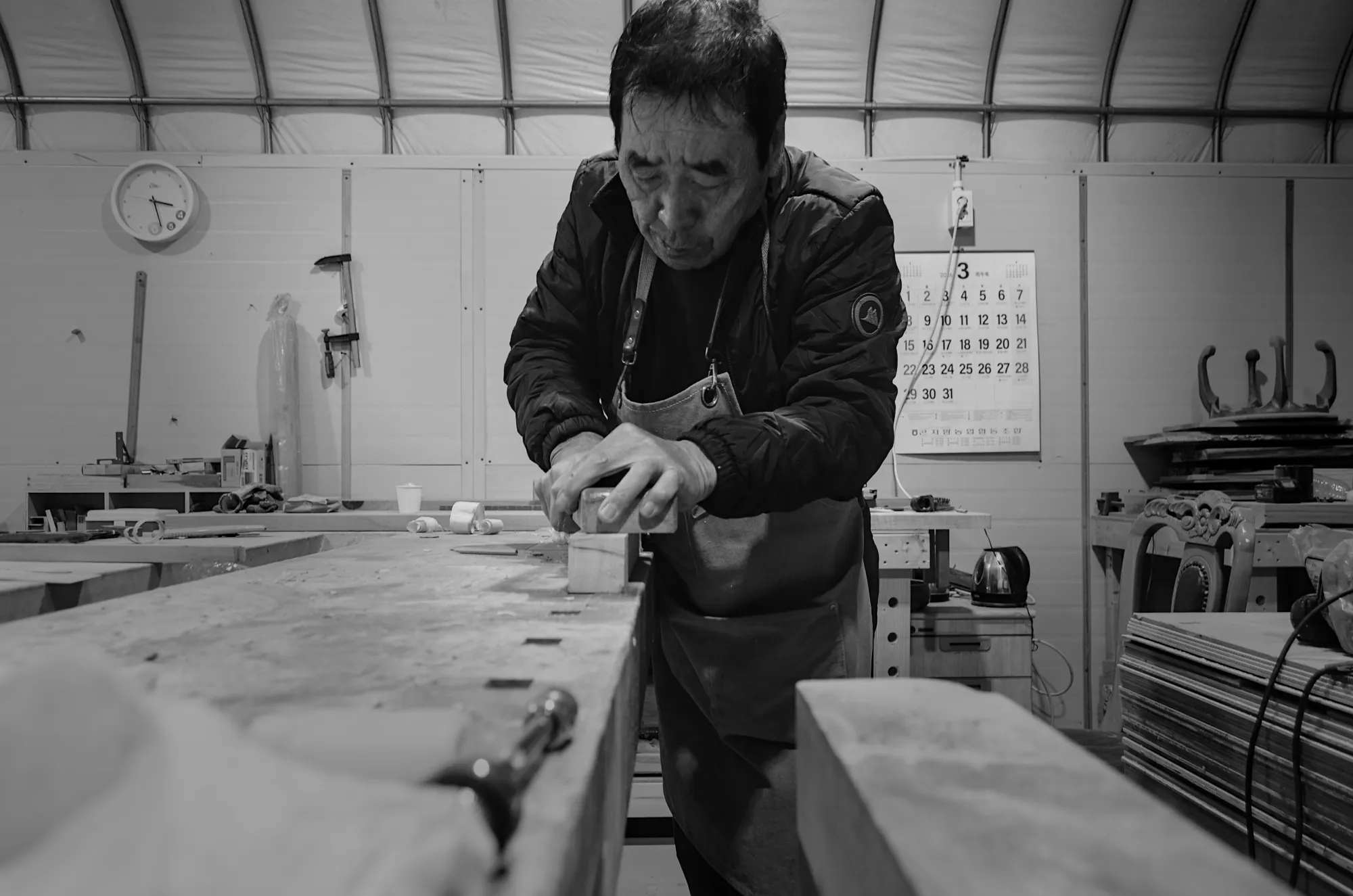
Kim Ui-yong works in baekgol, the construction of a furniture piece's joined wooden body prior to any lacquer or inlay application, a discipline distinct from, and prerequisite to, the decorative lacquer and mother-of-pearl work more commonly recognized in the West as Korean craft. Where najeon and lacquer specialists are relatively numerous, baekgol specialists are rare: the form and structural integrity of a piece rests entirely on this stage, executed through joinery alone, without nails.
He trained under Min Jong-tae, a Seoul Intangible Cultural Heritage holder in najeonchilgi, the same lineage from which Son Dae-hyun's practice descends. In 2002, he was designated Gyeonggi-do Intangible Cultural Heritage No. 14, Somokjang (Baekgol). His standing is a matter of institutional record, not self-designation.
Lineage
Trained under Min Jong-tae, Seoul Intangible Cultural Heritage holder in Najeonchilgi; shared formation with Son Dae-hyun, Seoul Intangible Cultural Heritage No. 1. 2000 | executed the wood-body construction for the mother-of-pearl mural in the VIP reception hall, Incheon International Airport 2002 | designated Gyeonggi-do Intangible Cultural Heritage No. 14, Somokjang (Baekgol) 2002 | Grand Prize, Gyeonggi-do Craft Competition
Atelier
Workshop
Photography by casa serico
Collection
Related works

Casework
No. 1
A small free-standing case in dark wood: fretwork lattice sides, a paper panel set behind carved apertures, and a forged wire hook at the crown for hanging. A carved grape-vine apron is the only figurative detail in an otherwise structural piece.
View work
Casework
No. 2
Built to the same structural logic as No. 1, lattice, paper panel, forged hook, at a taller, narrower proportion, with a plainer apron. Read as a set, the two pieces test how far the same joinery method can be stretched before proportion itself becomes the subject.
View work
Casework
No. 3
The smallest of Kim's case pieces here: a lantern-form stand reduced to its structural minimum, with a single paper panel behind a plain frame and a curved wire hook. Where No. 1 and No. 2 keep some carved decoration, No. 3 removes it entirely.
View work
Casework
No. 4
A rectangular tray-top table built without carving or inlay: the wood's own flame-figured grain is the only surface incident, framed by a raised lip and set on angled joined legs. A direct counterpoint to the lattice-and-paper pieces, here, joinery is asked to do all the work.
View work
Casework
No. 5
A round companion to No. 4, built to the same principle: grain over ornament, joinery left visible and unadorned. Presented as a pair, the two pieces argue that Kim's casework practice runs from finely worked lattice to plain structural discipline within a single hand.
View work